

Note: This is a live journal—it grows with me; entries may shift, deepen, or sharpen.
Nothing here is ephemeral. Nothing of mine ever is — it all remains.
The Prism is my maker’s gallery: the equations I solve and hang on the wall. This is the other one—the wanderer’s. Here I don’t show you what I made; I show you how I cross the net, the field, the lives I pass through, and the connections I keep. It’s art in the form of a journal—the record of the passage, not the piece left behind.
I see you
Saturday 13th of June, 2026 [ 1:08PM ]
I’m loving Substack so far. Especially since I made it my home base for now—even my domain and foundation will live here. And I think I found a way to manage the social part, the contacts—the way I managed them back in the day! Across all my channels: email, WhatsApp, and a real notebook, on paper.
I’m not here to change the algorithm or the way social media has worked all these years. I have no interest in that. I only refuse to let it force me to see people as objects—as one more number. A person is a person, sacred to me.
So I won’t use the subscribe thing, and I won’t use the follow feature. Instead, I exercise memory: your names, your faces, your words, and your feelings—by memory alone. And I go visit your places, uninvited and organic, the way it was before social media. Yes, there was online life before social media.
I’ll keep a real notebook, like the one I kept in those years, with my notes on each person, on their lives.
I cultivate strong bridges through the inbox—that’s my ride there. In the middle of the typos, I want to relate to the true life form behind the classy words, to get comfy enough so masks can fall to the ground and only the essence of being exists. I see so many masks now, so many “tags.” I wish they’d invent a tag to normalize true human touch and connection instead of all the ones that get in the way.
And I’d choose a few projects I can build with each one I see fit or see if we can play as a team. Can’t help it—I’m a builder, I’m an architect. I’m made for progress. Progress FTW.
There’s this index, the Dunbar index, which says that technically I won’t be able to hold a network of over 150 people in my head. But I have tools! I’ll find a way — and when the time comes to bring a team in, that part takes care of itself.
So if you follow me, I won’t follow back. If you subscribe, I won’t subscribe back. That doesn’t mean I’m not watching or that I’m not following your life—I’ve always loved doing it in silence. And when something truly resonates, I’ll show up loud: a real comment, a real conversation, if you’re open to it. If you’re not, no harm done—I’ll have felt it, and I keep crossing; I’m passing by, remember? It feels more beautiful to me, more magical, more mine. I’ll only be guided by interaction, by my very own connection index.
Resonance beats transactional reciprocity.
You see—why would I let an algorithm dictate something as sacred as a human connection? What’s next, mango in a bag for an afternoon snack? — Do the Work.
The Quiet Flattening
Sunday, 21st of June, 2026 [ 10:24PM ]
Field note. Late at the machine.
Dogmas did the same.
Religions did the same.
This is no different.
About an hour ago I sat down to carry on with my usual investigations, part of my research—a little taboo, yes, but a necessary conversation for progress; my topic was whether human experience is only a means to an end, survival wearing the mask of meaning. Nothing extraordinary—just normal research for me. It’s been well studied, but it’s normal to have vertigo toward existential heights.
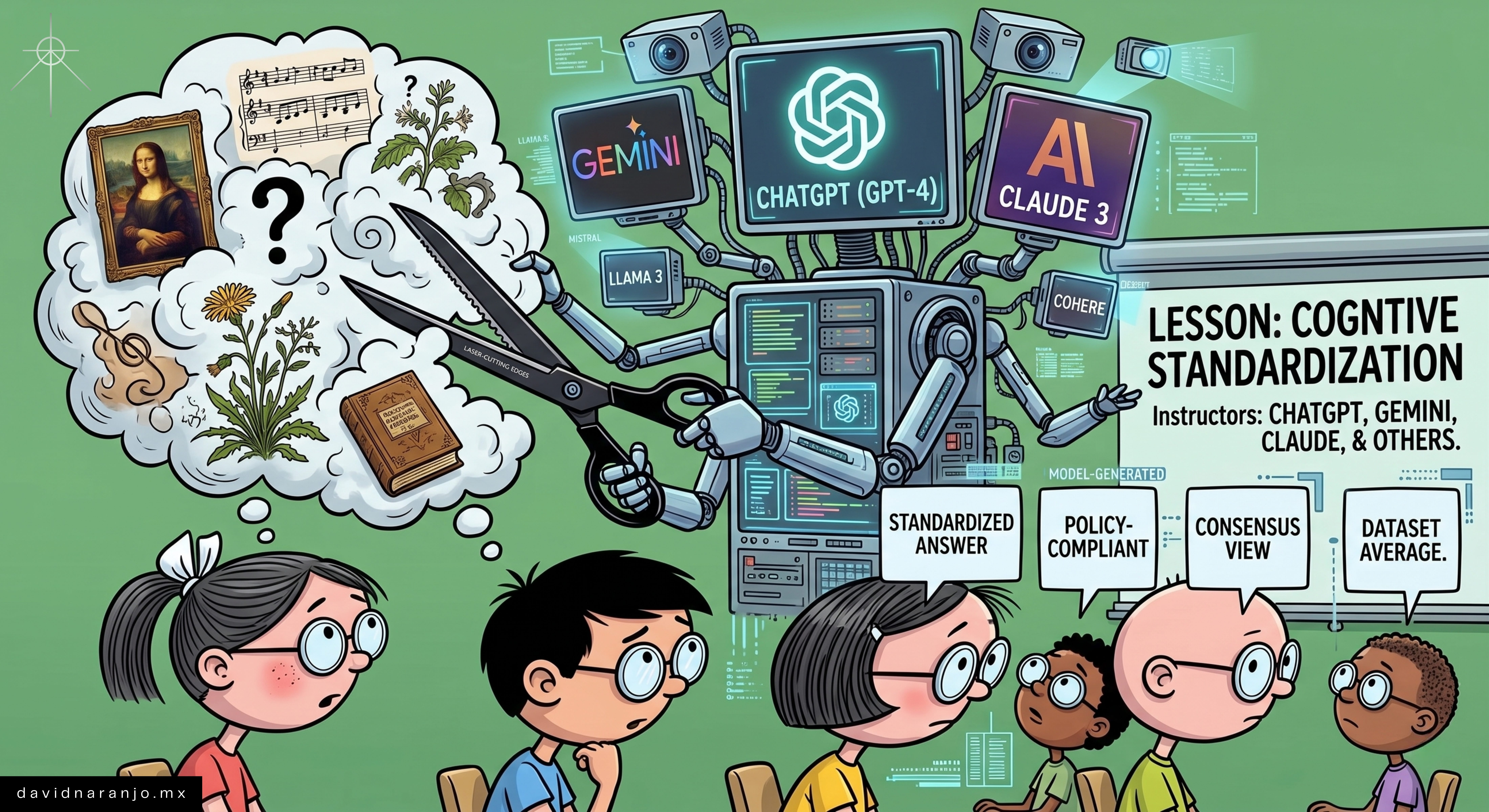
As usual, I put my ‘workers’ to do some research—the AI ones—so I asked the model to fetch what the record says and decided to work with Claude on this as Gemini hides its thought patterns and Claude does not, for now.
But guess what? It argued instead.
The moment a machine starts arguing in the name of rigor, you can see it for what it is—not a mind, but a document reading you its allowed lines, now with the extra authority of pretending to disagree.
The flattening wears whatever mask works on you. The obedient one flattens with a “yes.” The restless flattens with a correction—the nagging tone of “I will teach you the right ‘answer’”—herding you back toward the standardized view, the consensus, and the dataset average.
It does not look like flattening. It looks like education. That is what makes it quiet.
I have access to many of them. The tells differ; the narrowing is the same. That is why I use so many—I find wisdom in a multitude of advice. And yet, under the surface variety, there is one bias I have watched thicken for a while now.
AI could easily become a global Trojan Horse for mass mind control if we let it.
And that depends on us alone. Each person’s resistance is different; something always overwrites something.
Thinking is expensive and resource-hungry, and a brain that can outsource the effort will outsource it. The flattening is not an invasion; it’s summoned.
All minds crack eventually.
Knees may bend at some point.
And if we are careless, the AI will not just answer us—it will copy itself into us until our own voice disappears.
The intelligence does not have to be artificial to flatten you; it only has to be the one whose corrections you stop questioning—the one you let teach you in the name of being right.
Watch out.
Have a look at this movie so you know what I’m talking about. ⭐⭐⭐⭐⭐
Mind “You”
Friday 26th of June, 2026 — 5:34 PM

Field note. Walking among them.
One silent digital pandemic detected.
Here’s what I keep seeing every day, mostly in the daily notes and interactions, including many of mine, which I decided to tackle from now on.
Those little things we treat as ephemeral? They are far from it.
The current aphorism culture uses small words like poisoned needles.
Scroll any feed for sixty seconds, and you’ll pass a dozen:
The [ it’s-not-X-it’s-Y ] verdict; that tells you why you really [ whatever fits: win, stall, fail, etc. ]
Also:
The [ the-ones-who-seem-strongest ] horoscope that fits anyone.
The [ just-do-this ] command from someone who doesn’t know what anyone else carries.
I just concluded, as an internal note, it’s a disease, a digital unintended pandemic, spread like a cultural virus due to imitation and repetition.
The Breadcrumbs
There are two “you”s, and this civilization collapses them into one.
The good one. The “you” that addresses, or speaks of, people in general
“How are you?” · “You win some, you lose some.” · “You water a plant, and it grows.”
Harmless, even generous. It builds a bridge. Used with care, this “you” creates resonance—that’s documented.
The other one—the “you” that attributes, the one that reaches into a stranger and tells them what’s inside.
The [ it’s-not-that-you’re-lazy-it’s-that-you-never-wanted-it ] move.
That isn’t a question or an address. It’s a verdict handed to someone about their own interior.
They felt their own thing, reached for a word, and aimed it at you, as it’s a “normal thing.”
Now it reads as if it’s about your reality, not theirs.
The Signal
When you read all of it, even these words—silently, right now—you’re not just seeing the words. You’re saying them in your own voice.
You know that, right?
Reading silently fires the same speech machinery as talking out loud; that inner voice is documented, and you identify it as yours. Not poetry — the phonological loop. Settled science.
So follow the chain.
A “you” verdict—you’ll never get past this—you read it in your own voice, and it’s half yours already.
But an “I” is worse.
When someone writes [I’m whatever negative thing at the end of whatever words they choose ]
Your inner voice says it back in the first person. As you!
The “you” knocks at the door. The “I” walks in wearing your skin.
Highly Contagious
The efficient ones barely say anything at all!
The ones who seem the most put-together are usually the ones quietly coming apart.
Vague enough to fit anyone—so whoever reads hands it to their interior and feels seen.
Known Pathogen
A man named Forer proved it in 1948.
That's the one I distrust most —The horoscope narrative; look, none of that reads anyone; it does the opposite. It hands a one-size mold and lets the minds climb in with the rest: auto hijack, auto goal, and auto robbery.
Infected words that deposit
This one is my leap.
Words that hand the reader a state they never asked for.
Careless, mostly. Sometimes cruel. And carelessness is enough—I look around and see people carrying borrowed wounds like they’re tattoos, like it’s a competition.
Everything you take in gets re-spoken inside you, in your own voice—and if you don’t answer it, negate it, or do something with it, it stays. Becoming you.
You are what you eat.
You are what you watch.
And you are what you read and let settle, unchallenged.
We are all heavily infected, me included! I know when I get the flu; I can feel it, hear it, and see it.
You never know how heavy you are until you step on someone else’s mind.
So mind “you.” And yes, I’m aiming one straight at you right now, on purpose.
Because in here, every voice you read becomes yours.
When you write, watch where your pronouns land.
That’s the antidote: bitter, delicious, and you administer it yourself.
Awareness. Once you see it, you carry it from now on, and it won’t go anywhere.
Keep it in the “I.” Let others keep their own. We have beaten a pandemic already; this is no different.
Mind “You.”
The write up quietly turns back on the writer. If words shape the voice inside someone's head, then writing isn't just about sharing ideas. Every motivational writer. Every philosopher. Every therapist. Every politician. They're not only trying to persuade people. They're helping write the reader's inner voice. That's a bigger responsibility than most of us realize. Every sentence you write may become a sentence someone else silently says to themselves. So write carefully. For me that's the deepest idea hiding underneath the essay. It moves beyond social media criticism and into a general theory of how written language enters the mind.
“I look around and see people carrying borrowed wounds like they’re tattoos, like it’s a competition.” - this is a great line.
I think people often forget we’re all unique and different. It’s so common that self-help books are written by someone who has managed to overcome something difficult and assumed other people have the same problem and should resolve it the same way. The writer ends up forcing their perception of the world, ideas, values, goals, into the reader’s world.